Showing posts with label Puppy Dog. Show all posts

#1 - Start Training Early:
Puppies start to learn the moment they open their eyes and are most open to new experiences during the first four months. Start training your puppy the moment it is bought home. Good early habits endure and will result in a well behaved dog in the future.

#2 - Early Socialization:
Help ensure your puppy meet and socialize with as many people as possible during the first four months. Going on outdoor trips, visiting friends who own pets, and walking along busy streets should all be part of your puppy's education. These positive experiences will allow your puppy to be comfortable with humans and reduce the likelihood of any future behavior problems.

#3 - Mental And Physical Stimulation:
Every puppy thrives on both mental and physical stimulation. Exposing your puppy to new environments and experiences early can greatly enhance your dog's interest in learning new things. Puppy walks or games are great ways to stimulate your pet both mentally and physically. If actively stimulated, your puppy will become healthier and adept at learning new trainings faster. This will also help strengthen the bond between the both of you at the same time.10 Essential Puppy Training Tips

#4 - Hand Feed Your Puppy:
Whenever possible, hand feed your puppy. This teaches him/her to like human contact, even when your puppy is feeding from his food bowl. Not feeding from hand can lead your puppy to turn aggressive to whoever that tries to get near him/her while feeding.

#5 - Biting And Chewing:
Your puppy will certainly bite and chew while they play and investigate new things around them. If your puppy is teething; direct, encourage and reward your puppy to bite the right object (toy). Discourage and discipline by simply saying a firm "NO" and replace the object with the correct toy or training equipment.

#6 - Step-by-Step Training:
Always begin your puppy training at home where it is in a familiar environment and work on one new exercise, command or trick per training session. This will allow your puppy to learn, understand and familiarize each training better and faster. Trying to introducing multiple items at one session can confuse your dog and lead to a slower learning curve.

#7 - Best Time To Train:
Train your puppy when it is feeling hungry or before each of its meal. Your puppy will respond very well to food treats. This is especially useful if you are just starting out to train your puppy or you have certain difficulty with a particular command. Balance your rewards with praises and hugs so that your dog doesn't associate every reward with just food. Never begin any training with your puppy when you are feeling lousy or in a bad mood.

#8 - Housetraining:
Housebreak your puppy early by supervising and recognizing your puppy's body language such as circling or sniffing the floor. Take your puppy out every 45 minutes after eating or drinking as they tend to "let go" around this time. When it eliminates at the right location, praise and rewards your puppy so that it will associate eliminating outdoors as a positive experience.

#9 - Rewards And Punishment:
Different puppies learn at different speeds. Whenever your puppy obeys or performs to a certain command, praise and reward your dog immediately. This allows your puppy to associate learning with positive-ness and fun. Never use any physical corrections or harsh yelling when you puppy misbehave as this can cause fear and promote future aggressive behavior in your dog. Reprimand your dog by using a stern voice instead and only when you actually caught it misbehaving.

#10 - Training Sessions:
Train you puppy in short, frequent sessions. Puppies have a short attention span and will get easily distracted or bored. Train your puppy for ten minutes each session and then play with him/her with its favorite toy to stimulate your pup's learning process. Always end each training on a positive note with your puppy wanting more. This will allow your puppy to look forward to its next training session.
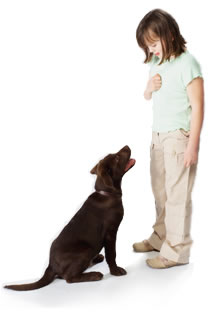
The command Sit! would be one of the first and easiest you want your dog to learn and memorize.

Whenever a dog hears his feeding dish being handled, or his leash being taken from its place it knows what’s going to happen. So the Puppy is very early able to understand the connection food - cup, or walk – leash and anticipate the outcome. This is exactly what we are going to take advantage of.

The moment the Puppy sits down by himself we say “sit”. Repeatingly using the sit! command whenever the Puppy sits down will make your dog connect action and command. As with the cup and leash example the dog will sit down although the command is happening before the action taking place. Of course the Puppy will only sit down if not “disturbed” by something of major importance.Train your dog to Sit!

You may start to back your command after a few days of practice, by gently pushing your dog’s croup down with one hand and keeping his head up with the other. In doing so, we repeat the command "sit", "sit" with a comforting voice. Should the dog sit for about 5 seconds, this should be followed by exuberant praise and visible exaltation.
Your body language and voice must be a clear signal to your dog, that it has just achieved something world-shaking.

Do not start to train any other commands in that period, and don’t exercise the sit! command 5 times in a row! Let some time go by and don’t forget the celebration whenever it works out. Slowly increase the complicacy: Both of you are laying on the floor playing and out of the sky there comes the command.

Make sure to be consequent! Never repeat your command! Enforce the execution right after the first command! Support your verbal command with a precise hand signal. As soon as this works, try just calling the dog by its name and the use of the hand signal only the moment the dog is looking at you.

The next steps are to train the sit! command at close range. Use a light leash starting from about 1-2 yards and keep increasing the distance. At this point I suggest introducing your dog to a new kind of signal, the dog whistle, also known as silent whistle. There might come situations in your dog’s life, where your verbal commands might not be heard because of excessive noise or simply the distance. The dog whistle is the perfect tool in those situations as it has a long distance effect.

Choose a unique signal for this command and start using it in exchange to your verbal command. Make sure that this signal is clearly distinguishable for your dog from all other signals you plan to use for further commands.

Most normal puppies will bite and chew. While you cannot completely erase this
behavior, they can regulate it and influence the puppy’s behavior. To control your puppy’s biting behavior, you should understand the reason behind it. Overall, puppy’s bite and chew because it is a learned behavior; however, learned behaviors can be changed.

Puppies learn biting behavior from his mother at younger age. Young puppies often play with their mouths by grabbing or biting one another. Controlling this learned behavior requires training your puppy because biting and chewing can be harmful for your family and friends.


How to train your puppy to stop biting


*Understand “bite inhibition.” Bite inhibition is the process of making your puppy know the difference between people and playmates. You need to train her and make her understand that biting hurts people whenever she tries to do it.

*Discover the reason behind her biting. One explanation may be anxiety or your aggressive behavior. You need to have patience while training your puppy. You should earn trust and socialize in a proper manner before your puppy is 4 months to teach her biting control. If your puppy trusts and respects you, the biting behavior can be alleviated. However, slapping or kicking your puppy for her biting behavior is not
the solution. Thes actions will lead to mistrust and disrespect and may make the puppy more eager to bite rather than control it.

*Allow plenty of time for your puppy to socialize with other puppies and dogs. Socialization will teach her restrain the biting behavior.

*Speak in firm tone whenever your puppy bites. A firm tone can minimize the intensity and frequency of her biting behavior.

*Avoid aggressive behavior such as yelling at or hitting your pupply. Yelling or hitting your puppy because of her the biting behavior minimizes your ability to alleviate her biting control. When a puppy does something right or wrong, you should show it by your behavior. For example, if your puppy does something right, then you should reward her. On balance, if she does something wrong such as engaging in biting
behavior, then you should show that you are unhappy by disengaging from her..

Every puppy behaves differently. Therefore, you cannot expect to use the same techniques to train two different puppies. You must adapt your training techniques based on the puppy’s behavior. Often, you need to be experimental and use trial-and-error to determine the best training technique to control the puppy’s biting behavior.

Only you truly know your puppy, so you will need to develop your own training techniques. Adapting continuous changes in your techniques is a good idea. Your puppy may try to gain your attention by nipping you with a “gentle bite.” At times nipping can also cause irritation, and you should make your puppy understand you don’t like this behavior by not responding to her nipping. Because biting can be harmful and dangerous to you and your family, you must adapt the necessary training
techniques to stop the puppy from biting.

Most normal puppies will bite and chew. While you cannot completely erase this behavior, they can regulate it and influence the puppy’s behavior. To control your puppy’s biting behavior, you should understand the reason behind it. Overall, puppy’s bite and chew because it is a learned behavior; however, learned behaviors can be changed.

Puppies learn biting behavior from his mother at younger age. Young puppies often play with their mouths by grabbing or biting one another. Controlling this learned behavior requires training your puppy because biting and chewing can be harmful for your family and friends.

Article Source: http://www.redsofts.com/articles/

The breeder you buy from plays a big role in how your Chihuahua will eventually turn out.

"You mean, not all Chihuahuas are created equally?", you ask. Exactly right. Anyone can "attempt" to breed a Chihuahua, there's no laws saying who can breed Chihuahuas and who cannot. This means that there are a lot of breeders out their who are breeding Chihuahuas who do not take the necessary steps to breed Chihuahuas that are temperamentally sound, healthy and confirm to the breed standard. This means that many Chihuahuas don't conform to the breed standard, they inherit diseases, and they have unsound temperaments.

Breeding Chihuahuas responsibly, to produce healthy and happy offspring, takes a lot of work and is very expensive. and this means that a lot of Chihuahua breeders take shortcuts.

So, If you want the best chances of getting a healthy, good looking, and happy Chihuahua then you must buy your puppy from a responsible Chihuahua breeder - not just any old breeder.

The breeders decisions before, during, and after breeding, play a huge role in how her Chihuahuas will turn out.

How To Buy a Happy, Healthy, Good-Looking Chihuahua Puppy

The three variables, listed below, are determined largely by the skill, or lack thereof, of the breeder whom you purchase your Chihuahua from:

  1. Appearance - your Chihuahua should conform to the breed standard so that he actually looks like a good-looking Chihuahua. Not all Chihuahuas look the same, some are much more true to their type (the Chihuahua breed standard) than others.
  2. Temperament - you want your Chihuahua to be confident and friendly. You do not want a nervous or overly aggressive Chihuahua who will be a handful around strangers and difficult to live with.
  3. Health - you want a healthy Chihuahua who is free from the hereditary diseases commonly found in Chihuahuas

Whether you get a healthy, happy and good looking Chihuahua, like this, is determined largely, as i mentioned before: by the breeder.

So, you should be seeking out a responsible Chihuahua breeder to buy your Chihuahua puppy from.

Responsible Chihuahua breeders aim to create happy, healthy, and true-to-type Chihuahuas.

However, keep in mind that nothing is guaranteed. Mother nature ultimately deals the last card... but... by choosing a responsible Chihuahua breeder you greatly increase the chances that your Chihuahua puppy will turn out to be happy and healthy.

So your mission is to find and buy your Chihuahua puppy from a responsible Chihuahua breeder - and overlook all the other charlatan Chihuahua breeders out there.

Yes, you could choose any old breeder to buy your Chihuahua puppy from, but beware that you are taking a larger risk of obtaining a Chihuahua will have hereditary disease and/or an unsound temperament and/or won't physically conform to the Chihuahua breed standards (faults in the way he looks).

Source:Chihuahua Puppies Guide

Everyone who owns a puppy or dog will eventually have to deal with and correct less than desirable behaviors on the part of their companion animal. There are a number of behaviors that should be nipped in the bud, including:

Jumping up on people

Dealing With Puppy Behaviors ProblemThis is one of those behaviors that many owners inadvertently encourage in their animals, since jumping up, wagging his tail and the like can be adorable in a young puppy. When that puppy is older, larger and heavier, however, this jumping up behavior ceases to be cute and begins to become annoying and even dangerous.


A large, heavy dog jumping up on people can be dangerous to young children and even to some adults, since a large, 100 pound plus dog can easily knock down a child or small adult. Since you as the owner are responsible for the behavior of your dog, it is important to nip this problem behavior in the bud.

The best time to do that, of course, is when the puppy is still small and easy to handle. When the puppy jumps up on you or someone else, gently place the puppy?s feet back on the floor. When the dog remains standing there, be sure to praise it extensively.

It is also important to give the puppy an alternative to jumping up. Puppies jump up on people to express their enthusiasm, so it is important to redirect this energy in a more socially acceptable direction. Try teaching the puppy to present his paw instead of jumping up.

When teaching the puppy to not jump up on people, it is important to be consistent. Consistency is important in any training program, and all members of the family must understand that the puppy is not permitted to jump on them.

Dealing With Puppy Behaviors ProblemPulling, charging and tugging on the lead
One problem you definitely want to nip in the bud is this one. It is important that the puppy learn to respect the collar and leash now, when he is still small and light enough to handle. Teaching this lesson to a 10 pound puppy will be much easier than teaching the same lesson to a 150 pound dog.

Using a good strong body harness or head collar can be a big help when training a puppy not to pull, or to retrain a dog that has already learned to pull on the leash. When first fitting a harness, it is important to allow the puppy to walk around wearing it, so that he can get used to wearing it.

The first thing your puppy must learn, and the basis of all subsequent training, is teaching your dog to heel. Teaching your dog to walk quietly at your side on a loose lead is the basis of all dog training, and until your puppy has mastered this vital skill he will be unable to move onto more advanced training.

When walking with a puppy on a leash, it is important to always keep slack in the leash. If the puppy begins to pull on the leash, the handler should quickly change directions. The puppy will then find itself lagging behind instead of forging ahead. The least will be loose except for the split second it takes to change directions. It is important for the handler to use a quick tug of the leash, followed by an immediate loosening, when teaching this lesson.

When teaching the puppy to walk properly, it is important to never allow the puppy to pull you around, or to forge ahead on the leash. Allowing the puppy to pull you around will teach him exactly the wrong lesson.

Sallie McConnell has been a dog lover all her life. Her specialty is puppy training. Visit this site for more information:
Dog Training Clinic 

Article Source Dog News Center and Article Directory http://www.dognewscenter.com

You're the proud owner of a new puppy. Unfortunately, you are also the not so proud owner of a soggy living room carpet. It doesn't take long to realize this can't keep happening. So what do you do? It might just be time to housebreak your new pet.

Housebreaking may sound painful but relax. It really isn't all that difficult. It is your dog's natural tendency to want to keep its living area clean so once the home is firmly established in your pets mind the problem will be resolved. There are several ways you can assist the process to move faster.

The first thing you want to do is be sure your pet is healthy to start with. If your pet has not been to the vet already, make an appointment. Your dog should be checked for overall healthiness and for conditions that would make house training difficult, such as cystitis and kidney or bladder dysfunction. While your pet is visiting the veterinarian, ask to have them checked for worms and parasites also by way of a fecal exam. Also bear in mind the truthfulness behind mothers' wisdom when she said "You are what you eat." A poor quality dog food, in addition to contributing to a poor nutritional state, can cause digestive problems resulting in loose stools, thus contributing to your pup's inability to control itself.
Housebreaking Your PuppyThe most important part of housebreaking your pet is close supervision. This is necessary because your puppy learns by repetition. If you see your dog showing signs of needing to relieve itself, then immediate action must be taken to get the animal outside to its designated area. Consistency in training is critical. Do not think being lax because it's cold or dark outside is acceptable or your pet will adopt these same attitudes.

Close supervision during housebreaking is also necessary because it gives you time to learn your dogs special quirks such as needing to urinate right after eating or a certain action they take prior to soiling the floor so you can watch for these actions and respond in the future. Also it allows you to correct a situation while it is still fresh in the dogs mind. While being very intelligent creatures, short term memory is not the strong point for most animals of this species and correcting them after more than a few minutes have passed serves no real purpose.

Another key to Housebreaking is giving your dog a limited amount of space. Baby gates across doorways or a pet crate help to make a more confined area and help your pet to recognize this as his living space. Their natural tendency is to go outside of their own living space to urinate so making this association for your pet will make your job easier. Lining this space with old news papers is a good idea at first as it facilitates a much easier cleanup of any accidents your pet might have. Also be aware that some surfaces are more pet-friendly than others. Try to confine your new pet to areas of the home with tile or vinyl floors which are much easier to clean. Avoid letting them have access to carpet or hardwood floors which retain odors and can be extensively damaged by an errant pup.

Remember to limit the amount of water your dog has access to at the end of the day as you will otherwise be making a walk with your pet in the middle of the night. A quick walk outside at regularly timed intervals is advisable to training as this helps your pet to set an internal schedule. Be certain to use a consistent keyword to tell your pet why you are out in the yard such as "potty" or "toilet" or anything you choose and do not return indoors until they have relieved themselves. Also remember to give praise when your dog relieves itself in appropriate places such as on newspapers or outdoors.

Again consistent training is the key. If your pet does have an accident indoors, correct the animal immediately and then clean the area using non-ammonia based products. Instead use an Enzyme based deodorizer to clean the area and be sure to remove all odor of the accident or the animal will repeat the behavior again.

If you follow these simple rules, your carpets and your new pet should be able to coexist peacefully and relatively free from stress.


Source: Dog Article courtesy of I-Love-Dogs.com

 Bringing a new puppy into the home as a new member of the family is an experience that everyone should have. Kids absolutely adore puppies, all of your neighbors have puppies, and now it's time for you to take part of this joy and fill your house with puppy love!

But before you bring home your first dog, there are five key items that you must consider before making this large commitment to raising another life in the house, even if it is just a dog:
5 Things Should Know Before Buying First Puppy
Puppies Need Plenty Of Your Time Invested

Puppies are like raising toddlers - they need constant supervision and require plenty of time to be devoted to training and housebreaking. And even when your puppy becomes familiar with basic training principles, he will still need additional supervision well into his adult years.

Entertainment is another factor to consider. Keep in mind that if you and your family are gone most of the day, at work or for any other reason, buying two dogs may help keep the animals entertained by each other.

If You Have Children, They Too Will Need To Be Trained To Handle The New Puppy

As mentioned above, puppies need an abundance of your time for training and care. If you have children in the house then you must factor in their need to be taught how to handle the puppy, what not to do in terms of improper guidance, and safety tips when playing with the dog.
5 Things Should Know Before Buying First Puppy
Puppy classes are an ideal choice to make for both you and your children. There is nothing better than hiring a professional dog trainer to help guide you and your children with proper puppy care.

Puppies Are Expensive

Perhaps the term "expensive" is a bit over the top, but for many families that are on a budget, raising a new puppy can take quite a bit from the old bank account. You will need to buy toys, treats, bones, registrations, training aids, food, and of course, veterinarian visits which consists of checkups and shots.

Puppies Do Not Stay Small Forever

Although this tip is obvious, you would be amazed at how many people gave up their dog because it grew too big, too fast. For some reason, we like to bring home a new puppy and forget completely that it may grow into a very large pet, depending upon the breed. Make sure that you do your due diligence and find out how big your new dog will grow when he becomes an adult.

Most Dogs Are Not For Lazy People

With the exception of a variety of toy breeds and miniatures, the vast majority of dogs will need plenty of daily exercise. These little guys need plenty of room to run around and play. They also need people to play with and toys to keep them entertained. This means you! If by any chance you prefer to live a sedentary lifestyle and cannot offer your time and energy to daily exercise, consider purchasing a breed that does not need much activity. 

 by: Daniel Waser

Adopting a new puppy can be one of the most exciting things that can happen to a person or a family, but that cute little fur ball can also cause a lot of stress, especially in the first few days of coming to his new home. If you have just adopted a puppy, there are a few things you need to keep in mind to make sure that this new addition to your family grows up healthy and happy. Below are 6 things you should do for your newly-arrived puppy:

6 Things You Should Do When Having A New Puppy1. Give your new puppy plenty of love and attention, particularly when he does something "right." Start communicating with your puppy the moment you bring him home. Don't wait for your puppy to make a mistake or do something wrong before starting communicating with him. If you start communicating with your puppy this way, you are essentially training your puppy that you are nice some times and not nice at other times.

2. Puppies love to chew so give your puppy lots of chew toys. You can make chew toys for your puppy or you can buy a few from your local pet shop. This way your puppy learns early one to chew on his toys instead of your shoes!

3. Have comfortable, warm bed for your puppy. If you intend for your puppy to live outside the house, make sure to provide him with weatherproof doghouse. The doghouse should be spacious too. If you decide to let your puppy sleep inside the house, you can use a rectangular wooden box for his bed. You can also check out crates and kennels sold at local pet stores..

4. Keep an eye on your puppy when small children are present. Puppies are practically no match for rambunctious small kids. Puppies can easily get injured and even killed when they are left alone with small children. Small kids generally don't realize that puppies are very fragile animals and that they should be handle with extra care and gentleness.
6 Things You Should Do When Having A New Puppy
5. Start your puppy on a regular feeding schedule the first day it arrives in your home. If your puppy is six months old or less, provide him 3 to 4 solid meals each day. During each feeding, give your new puppy all the food he can consume within 30 minutes. After 30 minutes, take away any leftovers. It is very important that you provide your puppy plenty of fresh drinking water in between meals.

6. Start training your puppy to go on regular bathroom breaks. Take your puppy to the same bathroom spot at the same times every day, if at all possible. It is recommended that you take your puppy on bathroom breaks after every meal and two to three hours in between his meals, and after he has taken a nap. At night, take your new puppy on late-night bathroom trips. This will train your puppy early on to go to his bathroom spot if he needs to urinate in the middle of night instead of doing it right in his crate.

Depending on your financial situation, the age of children in the home, and the amount of time you can dedicate to training a dog. 

Adult: Adult dogs have reached their full size, coloration, and coat so usually what you see is what you get. Their personalities are already established, however many of their learned behavioral manners can be changed. Adjusting to a new family and environment can be traumatic to older dogs. 

6 things to consider when acquiring and adult dog 

• Adult dogs most likely have had their vaccination shots, although they may need boosters. 

• Spaying or neutering probably has been done, which will cut down on your expenses. 

Select Puppy or Adult Dog?

• With an outdoor dog thats fully grown, you have a good idea what type of fencing and the size of the doghouse you will need. 

• Inside adult dogs are likely to be housebroken with adequate manners. 
• Eating habits are usually already established in adult dogs, but you may have to change them to suit your lifestyle. 
• Usually adult dogs are accustomed to collars and leashes, and may have had some obedience training. A grown dog with bad habits will take patience and a great deal of time and effort changing their conduct. 

4 things to consider when acquiring a puppy

• A puppy in a household with children should be carefully monitored when together. Petting and wrestling with a puppy is great fun for children but puppies are fragile and their bones break easily so make sure children understand this when playing with them. 

Select Puppy or Adult Dog?• Housebreaking a puppy takes time and is particularly tedious and aggravating for the uninitiated. Days or sometimes weeks will be spent on cleaning up after a puppy before it is housebroken. 

• Puppies are vulnerable to diseases not usually associated with adult dogs. They must be checked regularly and will need vaccinations and booster shots. 
• Spaying or neutering represent additional expenses of puppy ownership. 

 by: Lamar Deane


Jump to page: